Simplify Your Liquid-Liquid Extractions with Faster, Easier, and More Reliable SLE
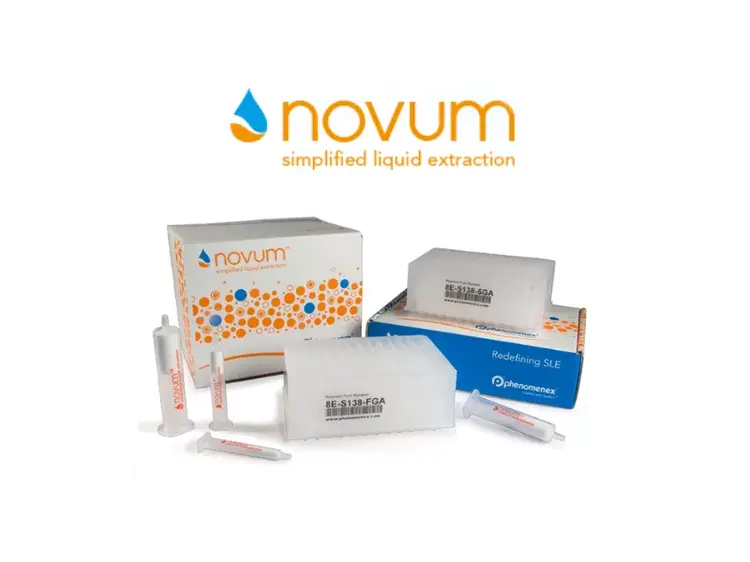
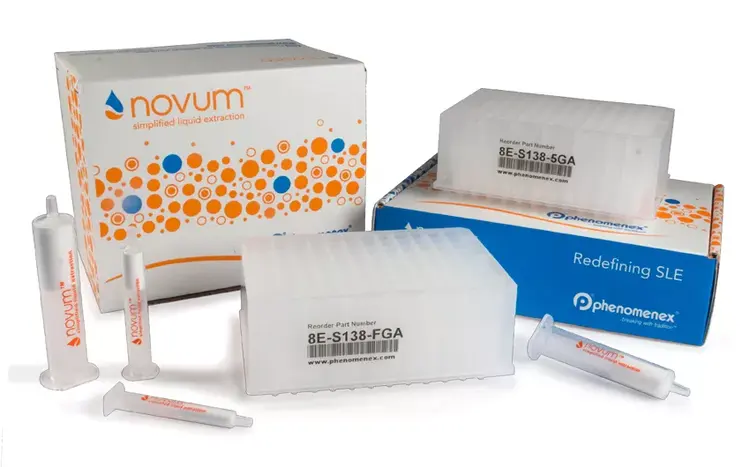
Novum Simplified Liquid Extraction (SLE) (patent pending) products are a faster, easier, and more reliable way to perform liquid-liquid extractions. In 3 easy steps and less than 15 minutes, you can remove unwanted interferences such as salts, proteins, phospholipids and more from a variety of samples without performing extensive method development.
New Novum PRO SLE to get down to low (LLOD) extraction levels from plasma
Novum SLE will instantly increase your throughput by eliminating time consuming steps and reducing the risk of analyte loss. If further time savings are necessary, Novum SLE can be easily automated for rapid, hands free sample cleanup.
Fast and Easy - Novum Simplified Liquid Extraction (SLE)
Estimated Time per Sample = < 15 minutes
- Dilute sample 1:1 with buffer or water and load onto Novum SLE sorbent using 2–15 seconds of vacuum
- Wait 5 minutes
- Apply elution solvent and allow to elute via gravity. Complete elution with 10 seconds of vacuum.
- Rapid, automatable method for high-throughput cleanup
- Stop worrying about analyte loss due to emulsions
How can I improve analyte recovery with Novum SLE?
The Novum SLE sorbent relies on mass transfer to help partition target analytes out of aqueous solvent and into the organic elution solvent. In order to boost recoveries of some assays, it may be necessary to dilute your sample more than the suggested 1:1 dilution in order to increase the surface area of the aqueous solvent/sample. When using the Novum Mini 96-well plate, samples can be diluted to a maximum of 300 µL. When using the Novum Max 96-well plate, samples can be diluted to a maximum of 450 µL. It may also be possible to boost analyte recoveries by increasing the amount of elution solvent applied to the sorbent.
What elution solvent should I use for Novum SLE?
In most cases, using ethyl acetate as an elution solvent results in an excellent balance between cleanup and recovery. If you are using DCM as an elution solvent and see low recovery of target analytes (particularly fluorinated analytes or those that have a negative logP value), recovery may be improved by adding 5-10% ethyl acetate to the DCM during the elution step. When working with acidic analytes, it is recommended that DCM or MTBE be used as an elution solvent.
What are my options for cell lysis for whole blood pretreatment?
Option 1: Osmotic Breakdown-Add 3 parts D.I Water to one part whole blood sample. Mix/vortex for 3-5 seconds Centrifuge at 3700 rpm for 10 min and collect supernatant • Option 2: Sonication-Sonicate whole blood sample for 15 min at room temperature and centrifuge at 3700 rpm for 10 min and collect supernatant • Option 3: Inorganic salts-Add three parts 0.1M Zinc sulfate/0.1M ammonium acetate solution to one part whole blood sample. Mix/Vortex for 3-5 seconds and centrifuge at 3700 rpm for 10 min and collect supernatant.
My sample is dissolved in organic solvent, can I use Novum?
No. Novum is a hydrophilic sorbent, it is intended for samples dissolved in aqueous solution. Samples in organic solution will either need to be dried down and reconstituted in an aqueous solvent, or they will need to be prepared using a different sample preparation technique such as SPE.
My sample is dissolved in organic solvent, can I use SLE to clean-up?
No, Novum and Strata DE are hydrophilic sorbents, it is intended for samples dissolved in aqueous solution. Samples in organic solution will either need to be dried down and reconstituted in an aqueous solvent, or they will need to be prepared using a different sample preparation technique such as SPE.
What capacity of vacuum pump should I use with an SPE vacuum manifold?
In order to achieve consistent flow rates when running multiple tubes simultaneously it is advisable to use a vacuum pump which can generate a vacuum equivalent to 20" of mercury.
What are the recommended elution volumes for Novum SLE? Can I use multiple aliquots for elution?
Please check Novum SLE User Guide for recommended elution volumes. If desired, you may perform multiple aliquots of elution solvent. For example, 3x 600 µL of elution solvent may be used instead of 2x 900 µL on the Novum MAX 96-well plate.
I am already performing a Liquid-Liquid Extraction. What buffers/solvents should I use with Novum SLE?
If you are already performing a liquid-liquid extraction, you may use the same buffers and solvents to perform SLE that you are using during your liquid-liquid extraction.
When using the 12- or 24-position SPE vacuum manifolds, what dimension of collection tubes can be used?
These manifolds have collection racks which can be adjusted to contain: 12 x 75 mm tubes (5 to 6 mL capacity); 16 x 100 mm (14 to 15 mL capacity) or 16 x 150 mm (23 to 24 mL capacity).